Divide and Rule
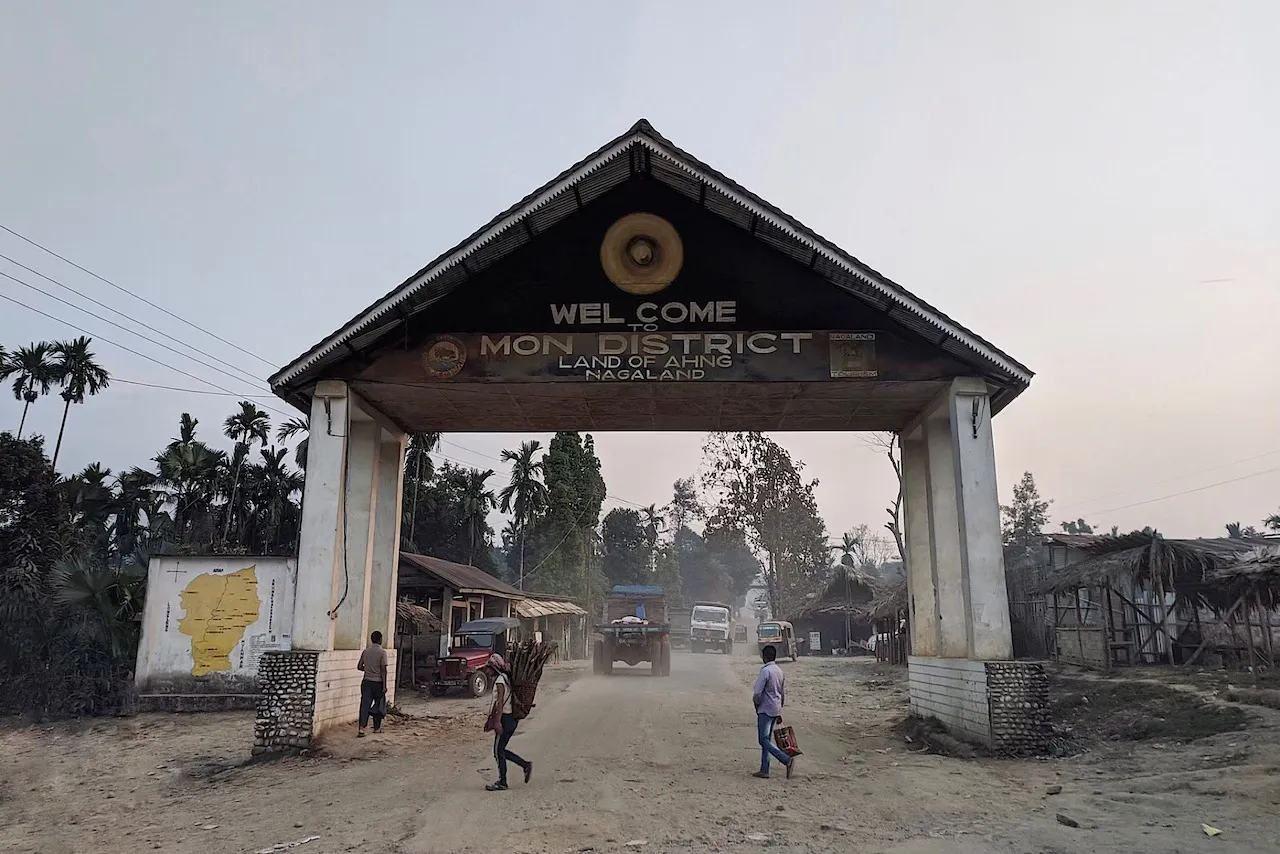 The border entrance to Nagaland and the Mon District, in Tizit
After a couple of weeks on the plains of the Brahmaputra River, I said goodbye to the tea plantations and was into the hills of Nagaland. In contrast to the Aryan-Dravidian peoples in India, the people of Nagaland are of East Asian descent – their languages a Sino-Tibetan branch. Before the British and the Baptist missionaries arrived, they were an animist land of headhunters.
Today Nagaland stands as a Christian nation, on the fault-line between the Hindu west and the Buddhist east. Nagaland (or Nagalim) declared independence from British India on 14th August 1947, that was before the Indians did, yet the Nagas have been fighting for it ever since.
Anyhow, leaving the main road in Assam towards the Naga border, I was a little anxious, worried that I may be turned back at the crossing for whatever 'new normal' reason. When I arrived, there was no barrier, I did half-see some officials but I tried not to look in their direction. I took a quick picture of the entrance to what is the Mon District of Nagaland, rode past a couple of what would have been useful hotels, and was on my way.
Across the border, the differences were notable; gone were any Indian people, bamboo and straw huts replaced concrete buildings, hills appeared in the near distance, and the roads became a mess of potholes, bumps and dust. It reminded me a little of the poverty of rural Cambodia, a land that the Indian government had seemingly forgot.
I rode on as darkness fell, through the still rather flat land, populated with farms, and with no easy place to camp – I would have to ask. After a while looking around, I stopped in a village and a helpful guy called Shawang said I should go back to a police barracks and they would assist. As it was, there wasn't much choice. So off I went.
After I arrived, the head police guy came – a Naga. We drank tea, chewed the betel nut, and chatted about his country, headhunters, snake meat, opium and the like! He said there are five million Nagas, spread between Indian states, and over in Burma. He seemed to put the separations down to the British 'divide and rule' policy. He said he wanted Naga independence and yet this was the armed police, paid for, in proxy, by the Indian government and whose job it was in-part, to suppress civil protests. Divide and rule continues, I thought.
The police chief made calls to the guys at the border – maybe I should have just stopped! The border police guys came and one guy – Ongam, took my details. Ongam was pretty helpful and happy to meet me, requesting the obligatory selfie (I could hardly say no). After the formalities, they took me to an industrial factory for plywood, where Indians from the 'mainland' came to work, where I was given a room and dinner. It was great to be back in remote lands – where you have to just go with it, ask for help, make do.
- ← Previous
The Little Hobo - Next →
Land of Headhunters