The Border Lands
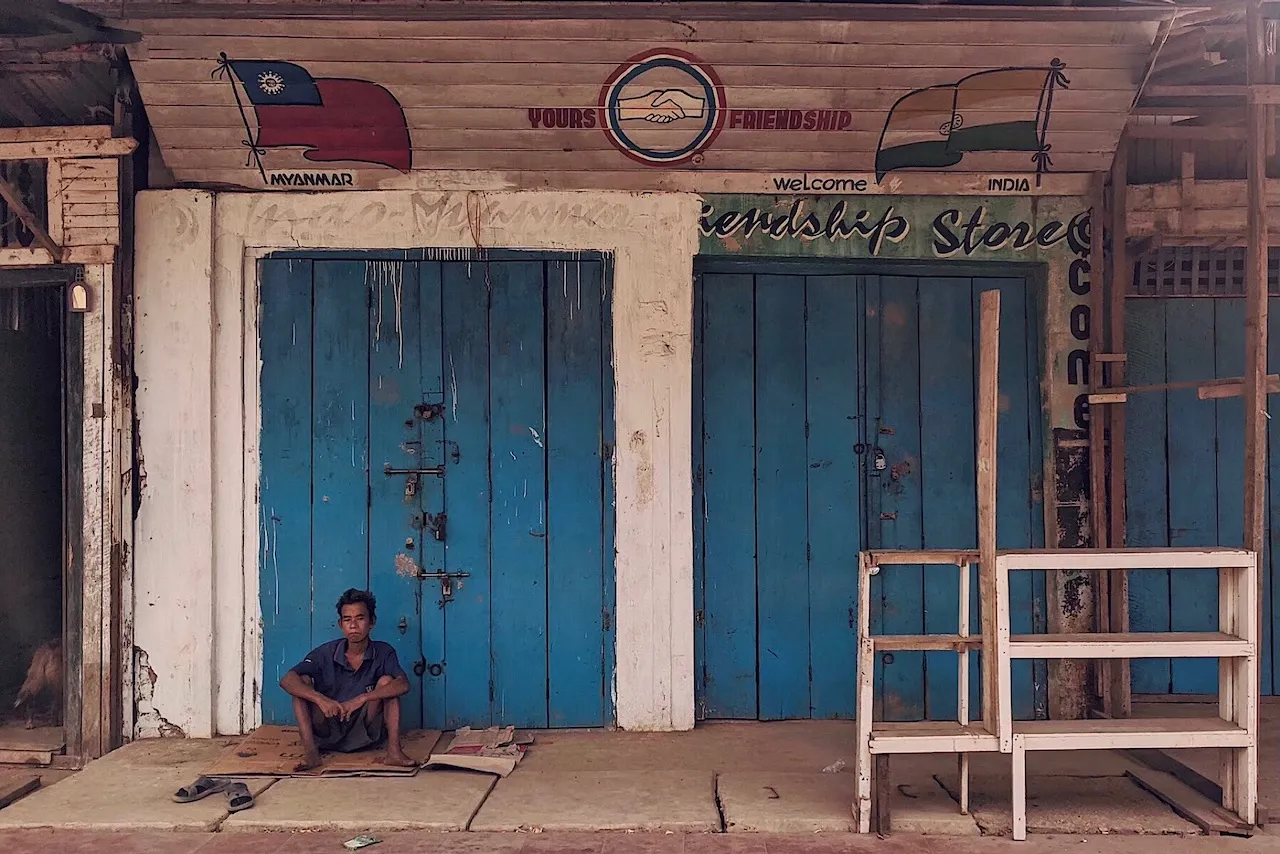 The old Burmese flag next to the Indian flag, on a shop-front near the Indo-Burmese border
Leaving Nagaland, I crossed the border at Mao (like the chairman), into to the former princely state of Manipur. In contrast to the Nagas, the Manipuris' (or Meitei) follow a Hindu sect – similar to other East Asian groups in the plains of Assam. The Meitei mostly inhabit the plains of the Imphal Valley, while the surrounding forested hills are occupied by Christian tribes such as the Kuki and Naga.
I felt a general unease in the first few days. I was extensively questioned at the border, and on the road to Imphal, one village had a sign up saying 'outsiders not welcome' – I wasn't sure if this was pandemic related or otherwise. After reaching the Imphal Valley, military jeeps with machine guns at the ready became a common sight. It seemed that the diversity of the state, plus it's strategic border location, made for a volatile situation.
Similarly to Nagaland, Manipur had succumbed to British invasions in the 19th Century (the Anglo-Manipur War) and likewise in the 20th Century, it saw a critical World War II battle – the Battle of Imphal. In the 1944 battle, the independence seeking Indian National Army tagged along with the Japanese, briefly raising their flag for their leader Subhas Chandra Bose, in the small village of Moirang.
Imphal had two moving cemeteries dedicated to those that gave their lives, one with over sixteen hundred British servicemen. Later in my trip, I would meet a local, named Rajeshwor, who worked with British organisations who still scouted for the unmarked graves of missing soldiers. His team would visit the sites of known battles throughout Manipur and search the areas using metal detectors. If they found a grave, they exhumed the bodies and sent them back to Britain.
- ← Previous
Ging Gang Goolie - Next →
The Road to Burma