The Road to Burma
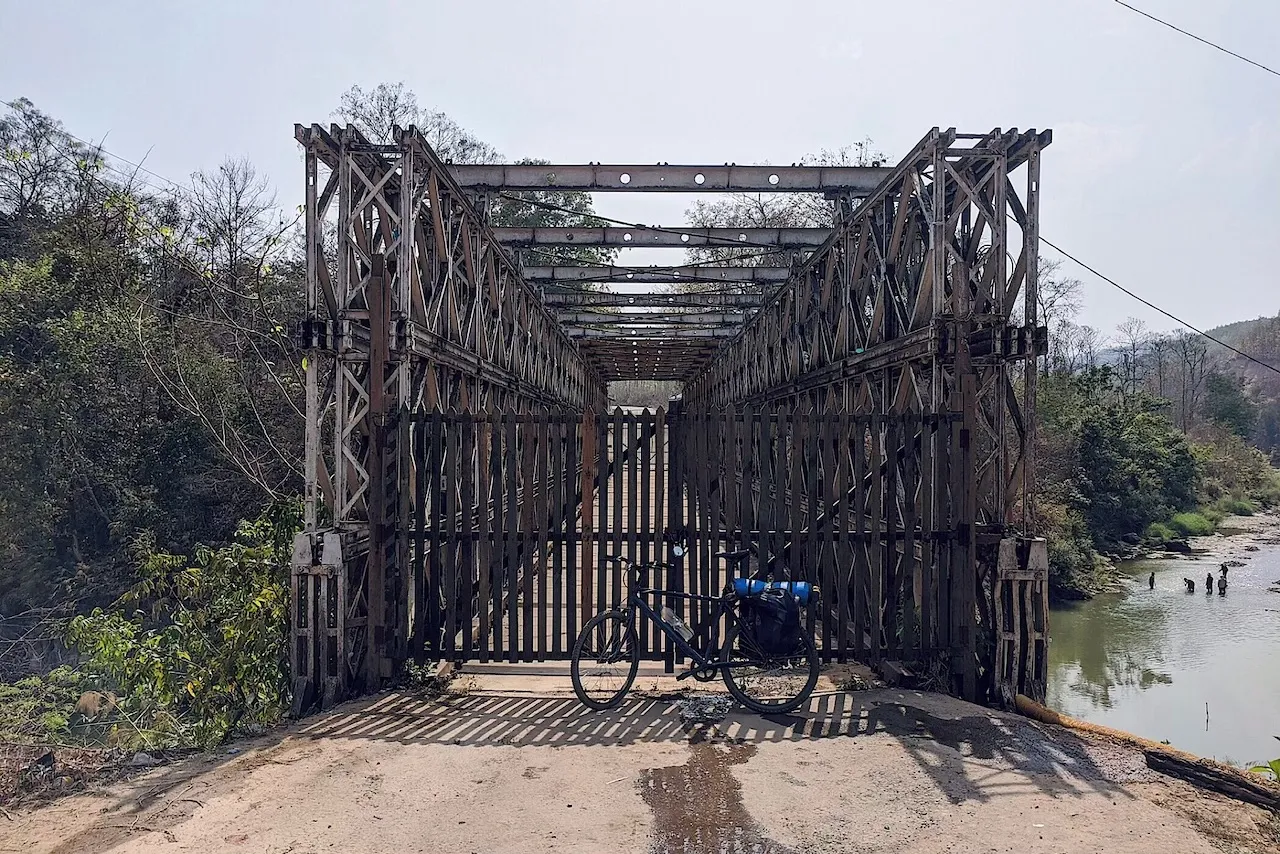 The padlocked bridge to Burma. In Moreh, Manipur, India
For the temple-bells are callin', an' it's there that I would be --
By the old Moulmein Pagoda, looking lazy at the sea.
—Rudyard Kipling, Mandalay
After a few days of rest in Imphal, I planned to cycle to the Burmese border. For as long as I remembered, the Indo-Burmese border had been closed – yet two years previously, it finally opened up. But now, like most world borders, it was once again, firmly shut. Plus, with the recent ousting of Aung San Suu Kyi, and the ensuing chaos, that closure had doubled-down. But I wanted to cycle as far east as I could go – I would have to pick up my tyre tracks in Burma another time.
I rode through the plains of the Imphal Valley and up the newly cut and relentlessly steep mountain road, towards the frontier town of Moreh. The road was so steep, it felt like cycling on flat tyres and I had to slowly zigzag up it. The closer I got to the border, the more heavily patrolled it was – checkpoint after checkpoint, each asking for the same details, filling in the same registrations. "I just filled in the same form in five minutes ago!" I would protest.
I eventually made it through to the last Indian town of Moreh. Though predominantly a Christian town of East Asians, it was religiously diverse. Beyond the churches, there were a scattering of Buddhist stupas, with many more visible across the border. Interestingly, there were several Tamil (south Indian) temples. The Tamil people migrated to Burma during the British Raj, but when Burma gained independence, the Tamils were deported, some relocating just across the border. Even more surprisingly, there was a synagogue and a small population of Jews, apparently a lost tribe of Israel – though many were now migrating to the Promised Land.
On my way to Moreh, as I was struggling up the hills, I'd met Pathou, who stopped his Enfield motorbike to share some chocolate cake. He worked for the border customs house and after I arrived, he showed me around and gave me the low-down on recent events. He said that there had been violent protests in Tamu – the town on the other side of the border. He had been hearing gunfire almost every day and just the day before, a defecting Tatmadaw (Burmese Army) had been shot and killed, only a stones throw from Pathou's workplace.
We had lunch together, past another few checkpoints, along the river which bordered Burma, one which eventually flowed into the Irrawaddy River. There we met a journalist for the news organisation ITV. He was the correspondent for South Asia and was here scouting for a story on recent events. He said he'd just seen some of the Tatmadaw nearby and started to snap. Obviously camera shy, they pointed their guns at his crew, so they wisely stopped.
After lunch, cycling on to the official border, there were more journalists, this time the BBC, who said they had just been interviewing political refugees, who escaped across the border. The border itself was just a narrow gated bridge across a shallow river. The gate was padlocked shut, but surprisingly there were no police or army in sight. People were swimming in the river below, and I could just make out the Burmese offices the other side. This was the road to Mandalay and Kipling's Moulmein Pagoda, but alas, not for today.
- ← Previous
The Border Lands - Next →
Storms and Slugs