The Hidden Kingdom
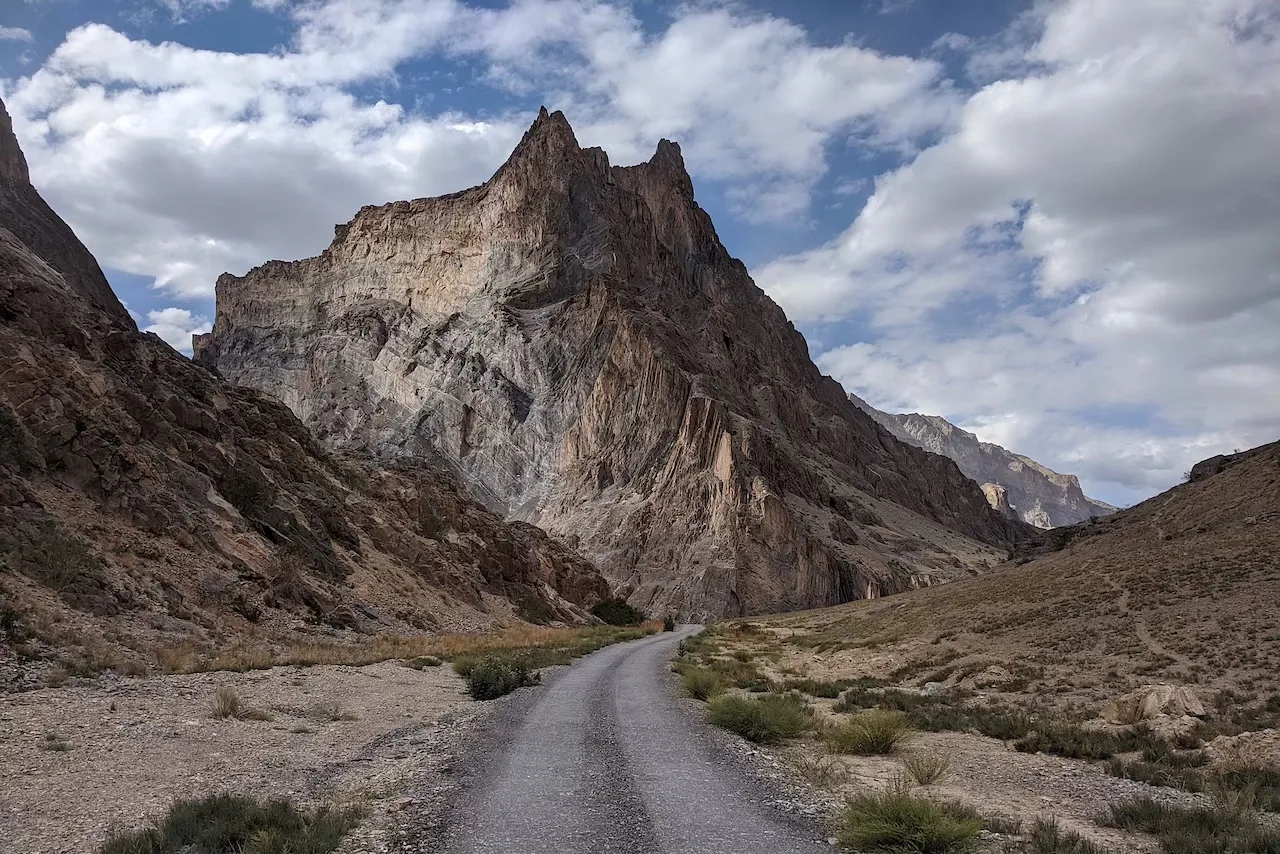 The lonely road along the Zanskar River, with an imposing granite mountain ahead
Zanskar, is a remote valley, hidden away in the cracks between the Great Himalaya and Ladakh. The ancient caravan trails, along the Silk Road, which criss-crossed most of Ladakh, never came this way.
Now, as part of their defence against China, the Indian's are turning high-altitude walking paths, into some of the highest motorable roads in the world.
The region had recently starred in a British made film called ‘Piano to Zanskar’. It was mad-cap story; hauling a piano from Camden Town in London, to Buddhist monks in a remote monastery in Zanskar, across the precarious trails of the Himalaya on the backs of donkeys.
During my time living in London, we bought a piano from the same guy at Camden Lock market, though that piano was only hauled a few hundred meters and by van, not by donkey!
First up, was to cycle from the middle land of Lahual, over the Great Himalaya Range, and into Zanskar via the imposing Shingo La, at 5,091m. The trail departed the main road to Ladakh at Darcha, so I headed to the base of the mountain pass, at Zanskar Sumdo and camped near a group of Indian coolies, working on the new road.
I slept on and off that night, perhaps due to already high altitude. I awoke at 5.15am, with deep cloud around and I wasn’t keen to start. I got going an hour later and the road was traffic free and happily asphalt, almost the whole way to the top. With my single-speed bike, I only had to push the last steep unpaved section, walking past and though the mesmerizing clouds.
The other side of the pass was a different matter, on the way down, my bike was rattling so much, I had to brake the whole way. As I descended, and approached small settlements at Tenzing Gonbo , I questioned whether this was truly Tibet. Everything I knew from my research said it was, yet after the pass, despite the standard Tibetan prayer flags, the first buildings I saw were plain stone cottages.
The Indian’s were not only completing an asphalt road over the pass, they were also planing a tunnel which would give them a quicker and more protected route to Leh. The stone buildings I guess were part of that project. The first official I met, said the tunnel was estimated to be complete in 2-3 years. But the state of the road, on the Zanskar side, I'd say even 7 would be a hopeful estimate.
As I came to the first village in Kurgiakh, I was met by the classic Tibetan style houses, the whitewashed walls, mud thatch roof, with holes for the rain - the exact same as Spiti. This village was the checkpoint and the official entrance to Zanskar. I was the first arrival since two Russians in March 2020, arriving on motorbike I assume.
The road onward was tough, not helped by numerous sections planted with layers or rock. Hard going. I managed 66 km for a 12 hour day, and apart from a quick omelet, I barley stopped. My energy level had sunk so low making it arduous work to find a campsite. Yet, reaching the majestic blue Tsarap River was a great end of the day. This was a river that led to Phugtal Monastery, dug out of the cliff and one of the last Buddhist monasteries in Ladakh that can still be reached only by foot.
The next day I cycled to the capital, Padum, a crossroads set in a stunning location with its back to the Great Himalayas, facing into a broad valley running along the Zanskar River toward the Zanskar range and over to Ladakh. To the west was Kashmir, the immediate south and over the great mountainous wall, were Hindu hill tribes.
The local restaurant felt like the scene from the Mos Eisley cantina in Star Wars, a wild setting with a vast mixture of different faces, from the bearded Muslims of Kashmir and beyond, to the mongoloid local Tibetans, and a scattering of Indians.
After resting in Padum, my onward route would take me over the Zanzskar range and into Ladakh proper. The first day out, I followed and slept next to the Zanskar river. The sleeping spot came too early in the day, but it was so great, I couldn't turn it down.
The next day, the ride, or walk out from the Zanskar canyon was really tough. I considered staying at Linshed -a guy who stopped and gave me a banana even said I should and how beautiful it was. Yet the road bypassed it and detours on a bike are a big ask.
I could make the pass today I thought, I’d be late but could get to the top by 5pm. A late crossing was a big no-no when crossing the Himalaya and it’s sub ranges, yet this was now the desert, and I was confident the weather wouldn’t change. So onwards I went.
I was already drained, had to push most of the way. It was an endurance task for 3 solid hours. The pass looked so far, so hard. I had to push, and kept stopping every few meters. Had to cheerlead myself on. Come on, keep going. Daydreaming of the top. Difficult to breathe, back sore, arms like jelly. Even the seemingly flat bits were a struggle. I had to stop every few yards to calm my beating heart. Getting back on the bike was too much, with my heart straining.
Finally I made it. But the joy was not immediate, it was a cold and exposed place. Quick pictures taken, jumper on, and then came the joy, and relief of the easy roll downhill, no effort required. The environment quickly changed, jagged snow topped peaks and green bushes along the streams.
I came down to the bottom, and by a river, there was a small camp of workmen, and as it was so remote, I thought it best to camp close to them. The workmen came from all over India, though usually the poorest states, and they worked on the road when it was snow free, living a simple yet hard life. They warned me of a tiger that was around, I was unconcerned, tigers didn’t roam these parts, a snow leopard perhaps.
Leaving Zaskar, I made it back to civilisation, joining the main road from Kashmir to Leh. I was so ragged by the time I made it to Leh, a local shoe fixer asked if it was the fashion to wear such rags.
- ← Previous
The Great Himalaya - Next →
Short Way Down